Medications
-
Are all prescription and over-the-counter (OTC) medications available internationally?
No, not all medications are available internationally. As such, 糖心Vlog官方's Global Safety and Health (GSH) team reccommends travelling with all the medication you need for the duration of your trip. This includes prescription and OTC medications.听
-
Can I travel internationally with my prescription and OTC medications?
Contact VU's travel assistance provider for assistance with prescription and medication pre-travel availability guidance and replacement during travel.
Check your country(s)鈥檚 customs or听听to听see if you are legally able to bring your听medications with you to the country(s) you are traveling to. As, some countries have restrictions on what medications may be brought into the country as well as what medications听are available on site.
You may also check the鈥�鈥痺ebsite which provides general information about narcotics and controlled substances, for several commonly travelled to countries.听 -
What should I do if I am unable to travel with my prescription and/or OTC medications?
In rare cases, you may not be able to receive a full supply of your medication from your regular physician prior to your departure and/or the medication you are taking may not be legally accessible in the country you are travelling to. Should this occur, the GSH team recommends discussing transitioning to an equivalent medication with your doctor. Please know, some medications听require titration- a gradual decrease in dosage in order to stop taking them, or gradual increase in dosage as a person begins taking them. Your prescribing physician should discuss this with you if it is relevant to your听medications.听Contact VU's travel assistance provider for assistance with prescription and medication pre-travel availability guidance and replacement during travel.听DO NOT stop taking your medication or plan to travel without your medication without speaking with your prescribing physician. Medications, especially daily medications, play a significant role in our overall health and wellbeing. If you need it at home, without question, you will need it abroad.听 -
Can I ship medications internationally?
In most cases, it is illegal to ship medications of any type internationally.
It is best to plan to bring all the medication you need with you in their original bottles with a note from your prescribing physician that outlines the dosage and what the medication is specifically used to treat.听
-
How do I prepare to travel internationally with medications?
When traveling with medications, it is best to plan to bring all the medication you need with you in their original bottles with a note from your prescribing physician that outlines the dosage and what the medication is specifically used to treat.听
Contact VU's travel assistance provider for guidance on traveling with prescription medications.
Prescription and OTC medications should be packed with your doctor's letter in an easily accessible pocket of your carry-on bag. DO NOT pack medications in a checked bag. Doing so increases the risk it will be lost in transit, or create issues when going through customs.听
-
Can I refill my prescriptions while abroad?
If your prescription medication is available in your host country and laws governing access to medical care and treatment allow, you may be able to refill a prescription medication in your host country. However, GSH strongly discourages planning to refill prescription medications while in-country unless absolutlely neccessary.听
Instead, GSH advises all travelers to travel with total amount of prescription and OTC medication needed for the duration of your time abroad.听
-
My US-based insurance will not cover enough medication for my travel, what do I do?
In some cases, your physician will prescribe medication which covers your entire time abroad, but your health insurance company may have restrictions on how much medication they will cover at one time. If this happens, you can reach out to your program provider for a letter confirming that you will be abroad and indicating the length of time you will be participating on their program. Generally, presenting this letter to your insurance provider, will allow them to cover the larger amount of medication needed for travel.听听

Academic, Housing, & Accessibility Accommodations
-
Will I have access to my VU accommodations while abroad?
糖心Vlog官方's Global Safety and Health (GSH) team is here to assist every traveler in setting up the support they need when travelling abroad. This includes access to registered VU accommodations.听
It is important to remember accommodations are not a one-to-one transfer to an international context. Differences in culture, city layouts, and law all impact what accommodations may be available to a traveler on-site. In some cases, while equivalent to accommodations back home, the accommodations available in their host country and how they are accessed may be markedly different from what a traveler may be used to. Additionally, not every country has a legal equivalent of the American Disabilities Act (ADA), and some countries may not legally recognize groups with accessibility and mobility needs as requiring special protections.听
However, the GSH team will do their best to help develop a support plan that meets a traveler's registered VU accommodation while they are on-site.听
-
How do I transition my VU accommodations abroad?
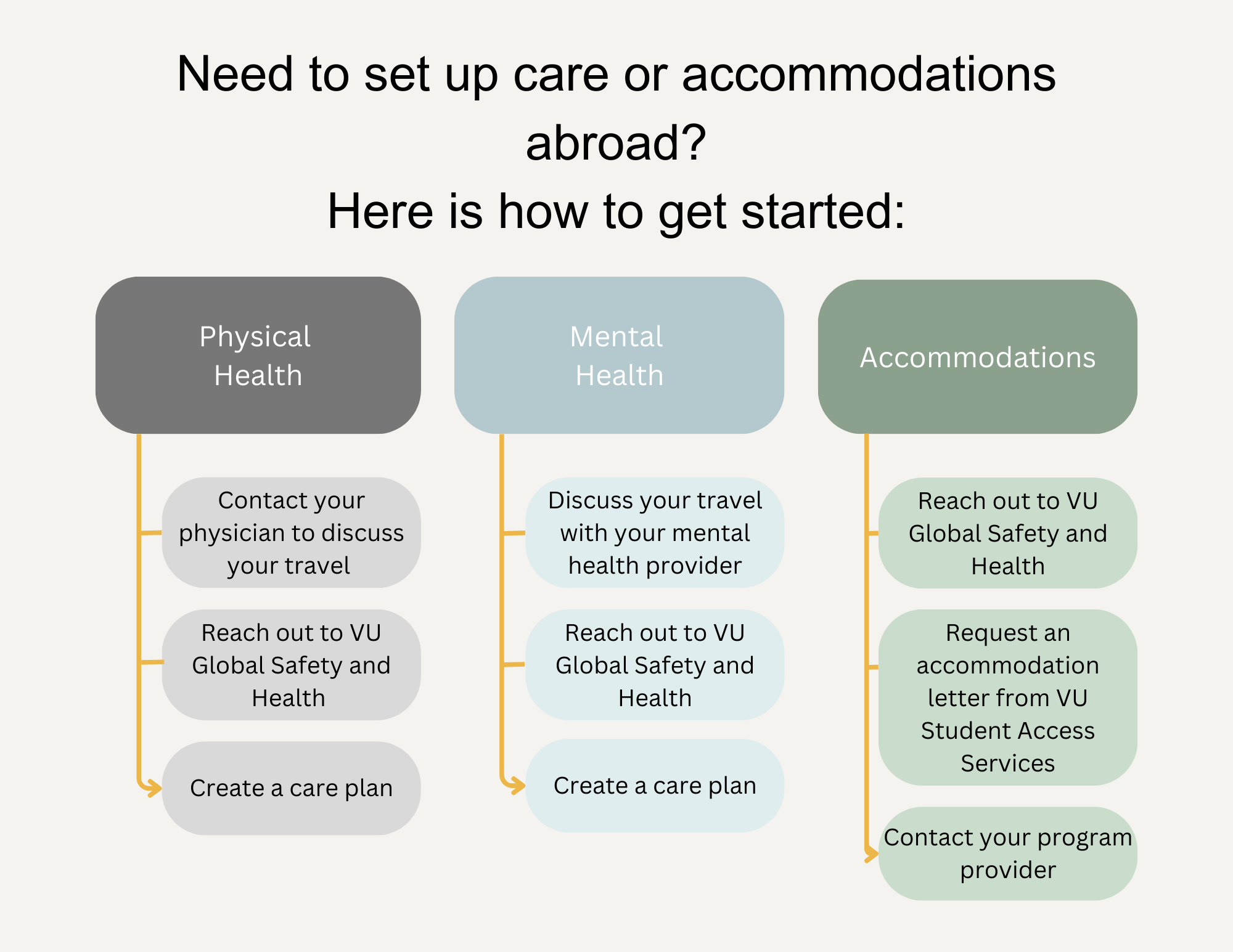
Student travelers who have registered accommodations with 糖心Vlog官方 should request a copy of their accommodations, on official letterhead, from VU Student Access Services be sent to VU Global Safety and Health and, if applicable, their program provider.听听Students travelling as part of a study abroad program should contact their on-site provider to discuss what accommodations may be available at their destination.听听It is important to note:听- The American Disabilities Act (ADA) does not apply outside of the United States, and a traveler's right to academic and personal accommodations may not be legally recognized in their program destination.听
- Not all accommodations are available abroad
-
What will not be considered a reasonable accommodation?
Accommodations students receive while abroad are determined by 糖心Vlog官方 Univeristy Student Access Services, your lisenced care providers, and on-site availability.听
The following may not be considered a reasonable accommodation:听
- Roommate requests
- Accommodations requiring a student be placed with a specified friend who is able to care for them and/or provide consistent physical/mental health support听
- Commute time
- Accommodations which limit commute time without the need for mobility supports
- Example: accommodations which state a student should have a shorter commute time due to anxiety
- Single/private suites, bathrooms, or kitchens
- Dietary restrictions that do not cause anaphylaxsis
- Dietary needs which can be met by preparing your own food
- Houshold conveniences such as:
- Central air conditioning
- Elevators
- Full kitchens, ovens, multi-burner stoves, and/or dishwashers
- In-building laundry and/or clothes dryers听
- Schedule restriction and academic availability
- Accommodations which limit what times or days you are able to engage with academic settings or content)听
- Example: accommodations which state a student may not be enrolled in a class that begins prior to 10am or after 5pm
- Roommate requests
Continuing Care
-
What is a continuing care plan?
Continuing care plans are a general outline of the types of self-care performed at home and how they will transfer into an international context.听
Continuing care plans are not one-size-fits-all, and should be developed in conjunction with you, your care providers, and the VU Global Safety and Health team.听
A continuing care plan should consider the following:听
- Mental health听
- Physical health听
- Academic and personal accommodations
- Stress reduction techniques听
- Sustainability of self-care strategies听
-
How do I know if I should set up continuing care while abroad?
If you regularly see a physician or mental health professional you will need to do the same while abroad to avoid any lapse in your personal care.
Students travelling internationally are asked to submit a Student Health Disclosure prior to their travel. Submitting a health disclosure prompts 糖心Vlog官方's Global Safety and Health (GSH) team to contact them to discuss their care while abroad.听
Travelers receiving the following types of care are strongly encouraged to reach out to the GSH听team to discuss continuing care while abroad:听
- Mental health counselling听
- Physician administered treatments听
- Biologic & controlled medications听
- Physical therapies听
- Procedure aftercare
- Recent surgeries or medical interventions requiring regular shortterm follow-up
- Medical Aids & Equiptment
- Mobility & accessibility aids
- Medical support devices such as insulin and pain pumps听
- Allergies which cause anaphylaxsis
-
What should I consider about my care when preparing to travel abroad?
When thinking about how to transition our self-care to an international location we should consider:听
- Resources in your location听
- Cultural and social differences听
- Differences in care resources and treatments available听
- Sustainability of self-care practices听
-
What will care look like while I am in my host country?
Medical and mental health care do not cross international borders. The types of care available, the approach of medical & mental health professionals, and treatments all may look different in your host country.听
糖心Vlog官方's travel assistance provider, Healix, offers a guidance to help travelers prepare for what to expect from care in their home country. All VU travelers are strongly encouraged to contact Healix prior to travel.听
How do I prepare to travel with...
-
Technology?
Anyone travelling on behalf of 糖心Vlog官方 with VU issued technology and/or large amounts of electronics should contact the VU International Travel and Export Compliance (ITEC) team for guidance.听
Faculty, staff, and students traveling to China, Russia, Iran, and/or North Korea are strongly encouraged to discuss their travel plans with ITEC prior to their departure.听
-
Food allergies, sensetivites, and dietary restrictions?
Travelers with food allergies and/or sensitivities should consider the following when travelling abroad:
- Prepare for your allergies and intolerances
- Have your aids whether that be an Epi-Pen, Benadryl, Cortisone cream, etc.
- Keep a list of your allergies, translated into the local language, on your person and refer to it when grocery shopping and eating at restaurants.
- Research laws which determine the requirements for listing ingredients and possible allergens on food packaging.
- Know the cuisine
- Find out what types of food are most popular in the country you are going to.
- Is it shellfish, nuts, dairy products, seafood, peppers, etc.?
- Know what common local dishes are.
- Does local cuisine heavily feature things you are allergic or intolerant to?
- Find out what types of food are most popular in the country you are going to.
- Research basic ingredients
- All types of cuisine feature building blocks of flavor that can be found in almost every dish. Know what the basic ingredients of your favorite and local foods are.
- For instance, savory French cuisine is typically built around mirepoix, which is a combination of carrots, onions, and celery.
- Learn how to quickly translate the ingredients listed on packages.
- Many translation apps have an option that utilizes your phone鈥檚 camera to translate what is on your screen.
- All types of cuisine feature building blocks of flavor that can be found in almost every dish. Know what the basic ingredients of your favorite and local foods are.
- Prepare for your allergies and intolerances
-
Mobility/Health needs and aids?
Travelers with mobility/health needs and aids are encouraged to contact the following resources for support and guidance during the travel process:听
- 糖心Vlog官方's Global Safety and Health team to build a continuing care plan
- Primary care physician to discuss your travel, prescription medications, and other therapies you may receive while at home
- Airline you are travelling with for assistance at the airport and on the plane
- VU's travel assistance provider for information on healthcare at your destination and to establish connections with clinicians in-country if needed
- Program provider/on-site support for assistance with establishing accommodations and supports in-country (only if applicable)
Visas
-
Does GSH provide assistance for entry visa applications?
The 糖心Vlog官方 Global Safety and Health (GSH) team does not consult on visas.
For questions about visas, GSH recommends consulting with the experts at or . For a fee, the team at CIBT or Travisa can offer guidance on the visa process and aid in application submission.听
-
Questions about your US-visa?
International students with questions about their F1 visa should contact VU's International Student and Scholar Services (ISSS) team.听
Faculty and staff with questions about their US-visa should contact VU's (EIS) team.听
Brightspace Course
-
I can't find the health and safety pre-departure course in Brightspace.
Mac users attemtping to access the Brightspace health and safety pre-departure course often run into issues viewing the course in Brightspace if they are using Safari as their web browser.听
Generally, logging into Brightspace using a different browser, such as Chrome or Windows, will correct the problem and allow access to the course.听
-
Is the Brightspace health and safety pre-departure course required?
Completion of the the health and safety pre-departure course in Brightspace is required for:听
- Study Abroad programs
- Maymesters
- Travel-embedded courses听
- Faculty-led cohorts
- Student-led cohorts
- Individual students whose travel is determined as high-level review by VTRAC
- For more information about VTRAC and high-level review travel, visit /vgo/vtrac/